Readiness
Clinical Placement Management Is a Team Effort
See how CareCard supports students, institutions, and clinical partners with clear requirements, document validation, and shared readiness information.

A student receives a list of placement requirements and starts gathering documents. Some records are ready, one appointment is still weeks away, and another document needs correction. The student is unsure what to do next. The coordinator sees an incomplete file, while the placement site is waiting to know whether the student will be ready.
Everyone is working toward the same goal, but each person sees only part of the situation.
Clinical placement preparation works best when students, educational institutions, and placement organizations can work from clear readiness information. CareCard supports that shared work while keeping the student at the centre of the process.
Give students a clear place to begin
Placement requirements can be difficult to understand, especially for a student preparing for a first clinical experience. Requirements may include immunization records, tuberculosis screening, CPR or Basic Life Support certification, a police record check, mask-fit testing, training, and site-specific forms.
Students need more than a checklist. They need to know what each requirement means, what evidence is accepted, when it is due, and what to do if a document is incomplete.
CareCard gives students a clear view of their assigned requirements. Instead of trying to organize instructions from several emails and documents, they can use their CareCard Profile to understand what is required and follow their progress.
Complete requirements one at a time
Students rarely receive every document at once. A certificate may already be available, a medical record may need to be requested, and a police check may still be processing.
CareCard allows students to upload documents as they become available. This makes placement preparation easier to manage. The student can focus on one requirement at a time while keeping completed and outstanding items visible in the same place.
Submitting a document does not automatically complete a requirement. The evidence may need review, correction, or validation. CareCard Verify shows the status of the submission so the student can understand whether it is awaiting review, accepted, or needs attention.
Make the next action clear
Uncertainty creates stress. A student who sees only that a file is incomplete may not know whether to upload another document, contact the program, wait for a review, or arrange a new appointment.
Clear requirement and review information gives the student a specific next step. If evidence is missing, the student can provide it. If a document needs correction, the student can address the identified issue. If the requirement itself is unclear, the student can bring a focused question to the appropriate institutional contact.
This does not remove the need for support. It makes support more useful because the student and coordinator can discuss the same requirement and status.
Help coordinators focus their follow-up
Coordinators support many students at different stages of preparation. Without shared information, they may spend significant time asking for updates, checking inboxes, and determining which issue is holding up each file.
CareCard helps authorized coordinators see the readiness information shared with their institution. They can distinguish between a missing document, a submission awaiting review, an item requiring correction, and a record approaching expiry.
This allows follow-up to be more direct. Instead of asking a student to review the entire file, the coordinator can focus on the requirement that needs action. The institution still determines its requirements and makes its own readiness and placement decisions.
Give placement partners relevant information
Placement organizations need confidence that students meet the requirements relevant to their settings. They may also have site-specific conditions that differ from the educational institution’s general requirements.
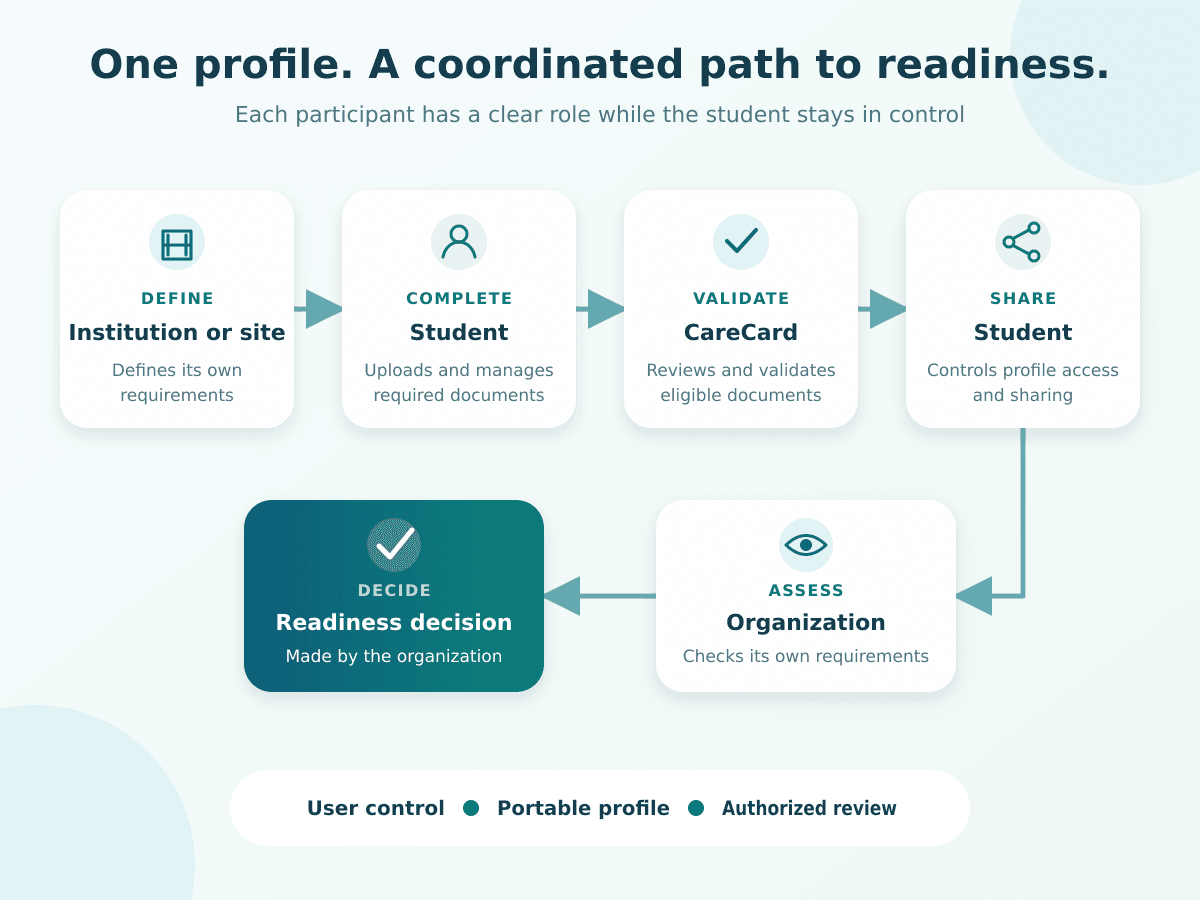
Through CareCard, students can share their profile with selected, authorized organizations or individuals. The receiving organization can review the information shared with it and assess that information against its own requirements.
Being part of a placement team does not mean that every participant should see every record. Access should reflect the person’s role, authorization, and need. A coordinator managing readiness, a site administrator confirming requirements, and a preceptor supporting learning have different responsibilities.
Keep the student in control
Students often submit the same records for several placements and then repeat the process when they enter employment. This creates more work and leaves important documents spread across different systems.
The CareCard Profile is designed to remain with the student. Eligible validated documents can be retained and shared with another authorized institution, placement organization, or employer when they remain applicable.
The receiving organization continues to apply its own rules. A document accepted for one placement may expire or may not satisfy another site’s requirements. Reuse does not remove review; it reduces the need to gather the same evidence again when it is still suitable.
This gives students greater continuity as they move through education, placements, and employment. Their records do not need to disappear each time an opportunity ends.
Support each role without replacing it
Clinical placement preparation depends on human judgment and communication. Students complete requirements and ask questions. Coordinators guide preparation and follow up on outstanding items. Educational institutions define program requirements and make placement decisions. Placement organizations apply their own conditions and prepare to receive students. Instructors and preceptors support learning and supervision.
CareCard does not replace these responsibilities. It gives the team clearer information to work from: what is required, what has been submitted, what has been validated, and what still needs attention.
A better experience for everyone
When readiness information is clear, students can prepare with less uncertainty. Coordinators can focus on the issues that need attention. Placement partners can review relevant information through an authorized channel.
The result is a more organized and supportive process. Students remain active participants rather than simply sending documents into an unclear review process. Institutions and placement sites retain their authority while working from information that is easier to understand and discuss.
Clinical placement management will always be a team effort. CareCard helps that team work together while giving students a reusable, student-owned profile they can carry into their next placement, program, or employment opportunity.